Rishta Aaya
HomeDesignsGun Mile ReportBlogContact

Jain marriage biodata format

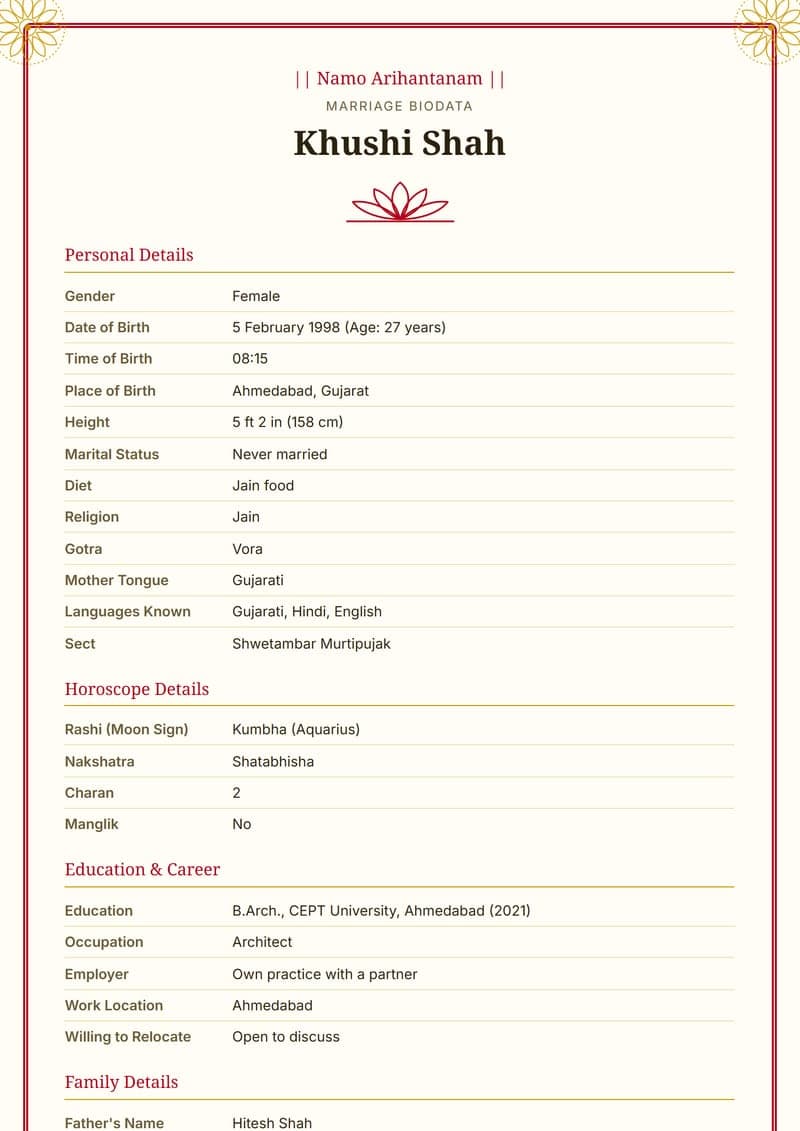
A Jain biodata tells families about sect, diet and native place along with education, work and family. Here is the format Jain families usually follow, with notes on each line and a sample you can download or fill in online.

Sample: Jain biodata format
Sample with fictional details

Make this biodata in 3 steps

  1. 1Fill in your details. Only name, gender and date of birth are required.
  2. 2Pick this design or any other, in your language.
  3. 3See the full preview free, then pay once by UPI to download the PDF and WhatsApp image.
Use this format

The Jain biodata format

A Jain marriage biodata uses the familiar order (personal details, horoscope if wanted, education and work, family, about me, contact) with a few lines that Jain families look for straight away.

Opening line

Many Jain biodatas open with the Namokar Mantra ("Namo Arihantanam…") or simply "Jai Jinendra". Others use a small Jain symbol, or no opening at all.

Sect and tradition

Write whether the family is Shwetambar (Murtipujak, Sthanakvasi or Terapanthi) or Digambar. Families use it to understand daily practice, festivals and the place of worship (derasar, sthanak or mandir).

Diet: be specific

Diet is often the deciding line in a Jain biodata, so go beyond "vegetarian":

  • Jain diet: no onion, garlic, potatoes or other root vegetables
  • Chauvihar: no food or water after sunset
  • Vegetarian: no meat or eggs, but not strict Jain food

Gotra and native place

Many Jain families write the gotra and the native place (for example Palanpur, Kutch, Marwar or Bundelkhand), even if they have lived in Mumbai or Chennai for generations. It tells the other family about customs and language at home.

Horoscope

Some Jain families match kundlis and many don't. Include the exact birth time and place so families who do can go ahead, and add rashi and nakshatra if you know them.

About me and expectations

Two or three lines, ideally mentioning how faith fits into daily life ("goes to the derasar on Sundays", "observes Paryushan fasts"). Then the partner expectations, which in Jain families usually include diet and sect.

Make your biodata now

Fill simple steps and see it update as you type. Free preview.

Start your biodata

Questions families ask

What is included in a Jain marriage biodata?

Name, date, time and place of birth, height, sect (Shwetambar or Digambar, and sub-tradition), Jain diet details, gotra, native place, education and work, family, a short about-me, partner expectations, a photo and a contact.

What goes at the top of a Jain biodata?

The Namokar Mantra, "Jai Jinendra", or a small Jain symbol. Some families begin with "Shri Mahavir Swamine Namah".

Should a Jain biodata mention diet?

Yes. Most Jain families want to know whether the person follows a strict Jain diet (no root vegetables), keeps chauvihar (no food after sunset) or is simply vegetarian.

Do Jain families match kundlis?

Some do and some don't. Including the birth time and place, and optionally rashi and nakshatra, lets families who do match go ahead without asking.

Why write sect on a Jain biodata?

Shwetambar (Murtipujak, Sthanakvasi or Terapanthi) or Digambar tells families about practice at home and in the derasar or mandir, which matters to many of them.

Other formats

Helpful guides