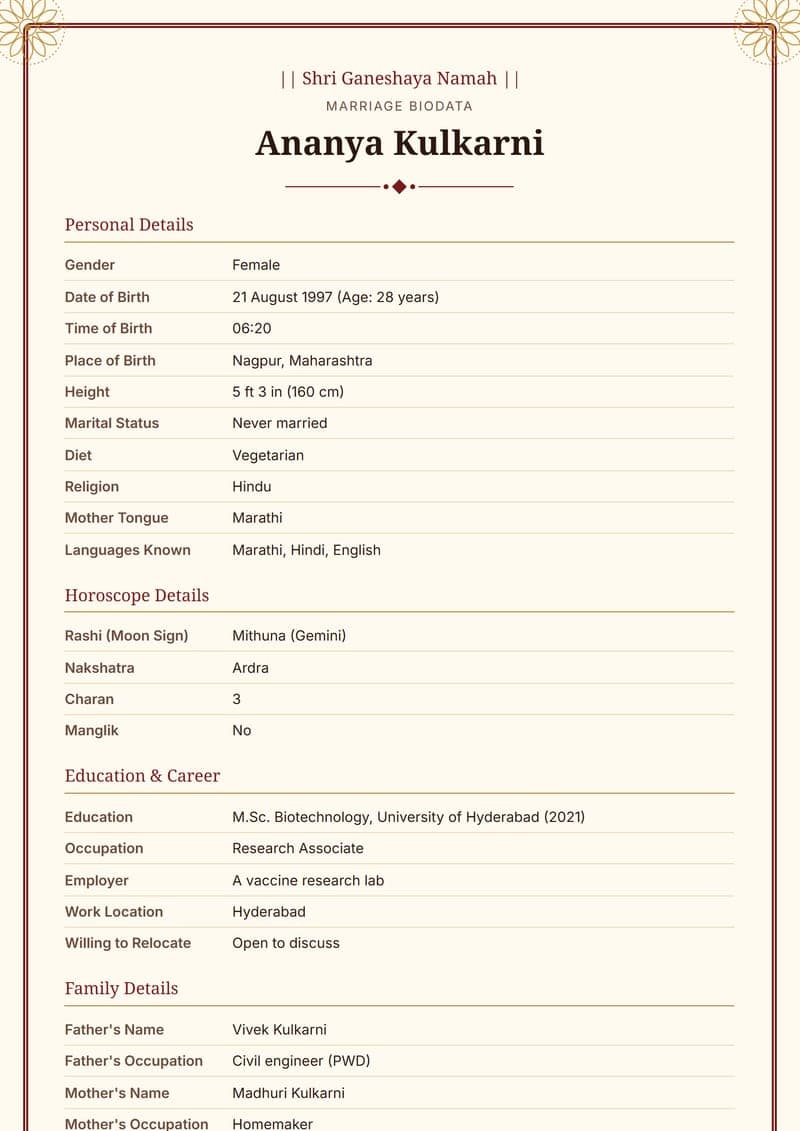
The standard biodata format, section by section
Most Indian families read a biodata top to bottom in the same order. Keeping to it is a courtesy: the other family finds what they are looking for in seconds.
| Section | What goes in it | Example from the sample |
|---|---|---|
| Blessing (optional) | A line from your tradition | ॥ श्री गणेशाय नमः ॥ |
| Personal details | Name, date, time and place of birth, height, diet, religion, mother tongue | 21 August 1997, 06:20, Nagpur; 5 ft 3 in |
| Horoscope (optional) | Rashi, nakshatra, charan, manglik status | Mithuna, Ardra, charan 3, not manglik |
| Education and work | Highest degree, institution, job, employer, city | M.Sc. Biotechnology; Research Associate, Hyderabad |
| Family | Parents and their work, brothers and sisters, family type, native place | Father a civil engineer; one younger brother |
| About and expectations | Two or three lines in the person's own words | "Patient, cheerful and close to my family…" |
| Contact | Who to call, and how | Father's name and number |
1. A blessing at the top
Many families begin with a line such as ॥ श्री गणेशाय नमः ॥, Om, Ik Onkar, Bismillah, a cross, or the Namokar Mantra. It sets a respectful tone and tells the reader something about the family. It is entirely optional; modern biodatas often start straight with the name.
2. Personal details
Write each item on its own short line: full name, date of birth, time and place of birth, height, diet, religion and mother tongue. Give height in both feet and centimetres ("5 ft 3 in (160 cm)") because families abroad and in India read it differently. Leave out weight and complexion; they add nothing and good families don't ask for them.
3. Horoscope details
If your family uses kundli matching, add rashi, nakshatra, charan and manglik status. If you don't know them, the exact time and place of birth are enough, because they can be calculated. If the birth time isn't known, say so honestly rather than guessing.
4. Education and work
The highest degree and where it is from is enough; there is no need to list every school. Then the current job, the employer (or the kind of company, if you prefer not to name it) and the city. Families care about the city as much as the job, because it decides where the couple will live.
5. Family details
Parents' names and what they do, then brothers and sisters with whether they are married. Add the family type (joint or nuclear), native place and, if your family likes, one or two close relatives such as a mama or chacha.
6. About me and partner expectations
This is the part people remember. Two or three sentences, ideally in the person's own words, about what they value and how they spend their time, followed by one or two lines about the partner and family they hope for. Be specific and warm; avoid lists of adjectives.
7. Contact details
The name of the person to contact (usually a parent) and a phone number. If the biodata will be forwarded widely, share the home address only after a family shows interest.
Mistakes that make families skip a biodata
- Two or three pages of achievements
- A group photo, a dark selfie or a heavily filtered picture
- Mixing languages in the same line
- Exaggerated income or job titles, which always come up later
- Missing the one thing every family asks: who to call
Below you'll find a format for your religion, your language and your situation, each with its own sample.