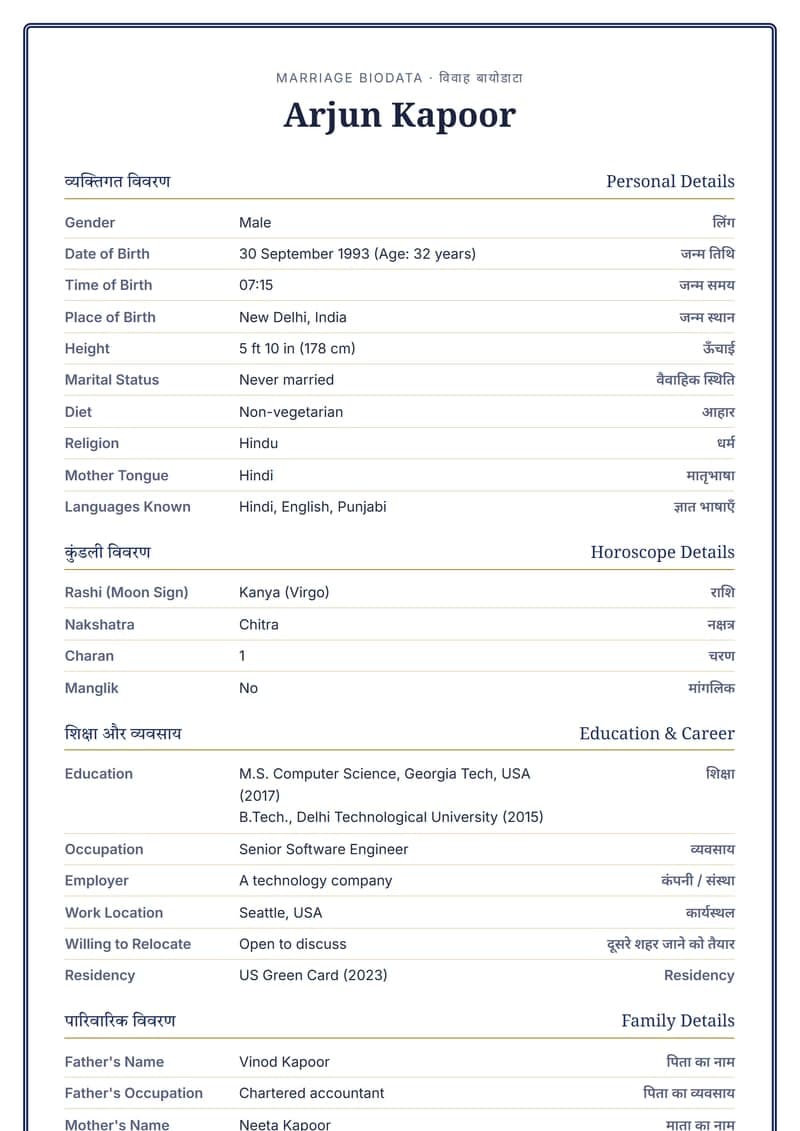
The NRI biodata: what's different
An NRI biodata has the same sections as any biodata. What changes is that it must answer the questions families in India will have about life abroad, and stay readable for families abroad too.
Where you live, your status and your plans
These three lines matter more than anything else on an NRI biodata:
- Country and city where you live and work
- Status: citizen, permanent resident (green card, PR, ILR) or work visa (H-1B, work permit), and since when
- Plans: staying abroad, open to returning, or planning to return by a certain year
A girl's or boy's family in India is deciding whether their child will move across the world. Clear answers here are the most respectful thing your biodata can offer.
Use both units
Write height as 5 ft 10 in (178 cm). Families in India think in feet; many abroad think in centimetres.
Birth details abroad
If you were born outside India, write the local time and place of birth exactly as on your birth certificate. Don't convert it to Indian time. Kundli software uses the place's own time zone, and a converted time gives a wrong chart.
Two contacts, two time zones
Give a contact in India (usually a parent) and one abroad, with country codes, and a good time to call, for example "evenings US time = mornings IST".
A bilingual biodata
The NRI design prints English and your family's language side by side, so grandparents in India and cousins in Toronto can both read the same page. You fill the details once.
Partner expectations abroad
Be specific about what life abroad would look like: where you'd live, whether the partner could work (and on which visa), and whether you might return. "Her career will be fully supported; H-4 EAD or her own visa" answers a question every family has.
Make your biodata now
Fill simple steps and see it update as you type. Free preview.
Start your biodata