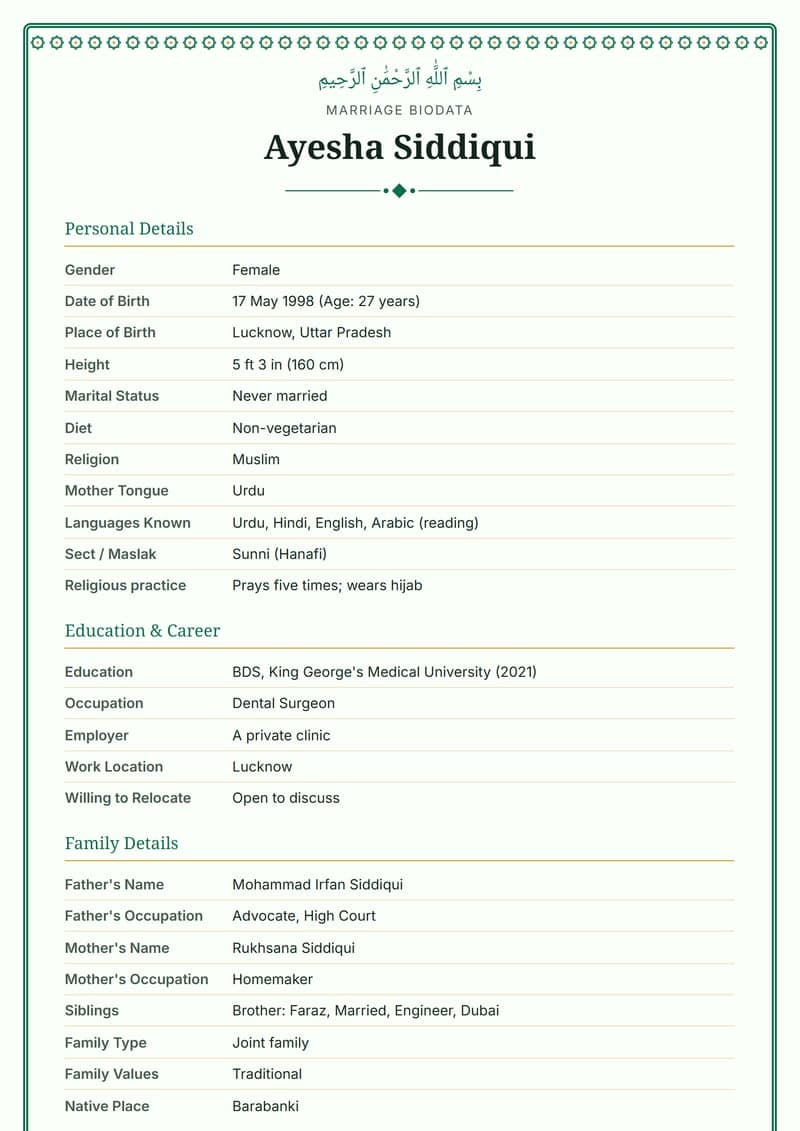
How a Muslim biodata differs
A Muslim marriage biodata has the same overall shape as any Indian biodata (personal details, education, family, about me, contact) with three differences:
- No horoscope section. Rashi, nakshatra and manglik status are left out entirely, and birth time is usually not needed.
- Sect and maslak. Families often write Sunni or Shia, and the maslak (school of thought) such as Hanafi, Shafi'i, Deobandi, Barelvi or Ahl-e-Hadith. It helps families with similar practice find each other.
- A line about deen. Many families describe religious practice in a few words: whether the person prays regularly, reads the Quran, wears hijab or keeps a beard. This is entirely optional.
The opening line
Most Muslim biodatas begin with Bismillah ir-Rahman ir-Rahim in Arabic script, or 786, the numerical form commonly used in South Asia. It is a blessing, not a requirement; a clean biodata that starts with the name is equally respectful.
Family section
Muslim families often place a lot of weight on the family section. Write:
- Father's and mother's names and work
- Brothers and sisters, with whether they are married and where they live
- Joint or nuclear family, and the family's native place (watan)
- Optionally, one or two well-known relatives, such as a mamu or chacha, if families in your circle would recognise them
Education, including religious education
Write the highest degree and current work. If the person is a hafiz or hafiza, or has studied at a madrasa (alim or alima), add it: many families value it highly.
Partner expectations
Keep this about values and practical life: "practising, educated, from a respectful family, supportive of her profession". Leave mahr, gifts and wedding arrangements out of the biodata. Those are for the families to discuss in person, and never belong in a first introduction.
Designs and languages
The Muslim design opens with Bismillah in a calm green and gold frame. You can also choose any modern design. The biodata can be made in English, Urdu (right to left), Hindi or any other supported language.