How Many Gunas Should Match for Marriage?
How many gunas should match for marriage: what 18, 24, 28 or 32 out of 36 means, when a high score still needs care, and when a low score can still work.
31 October 2026 · 3 min read
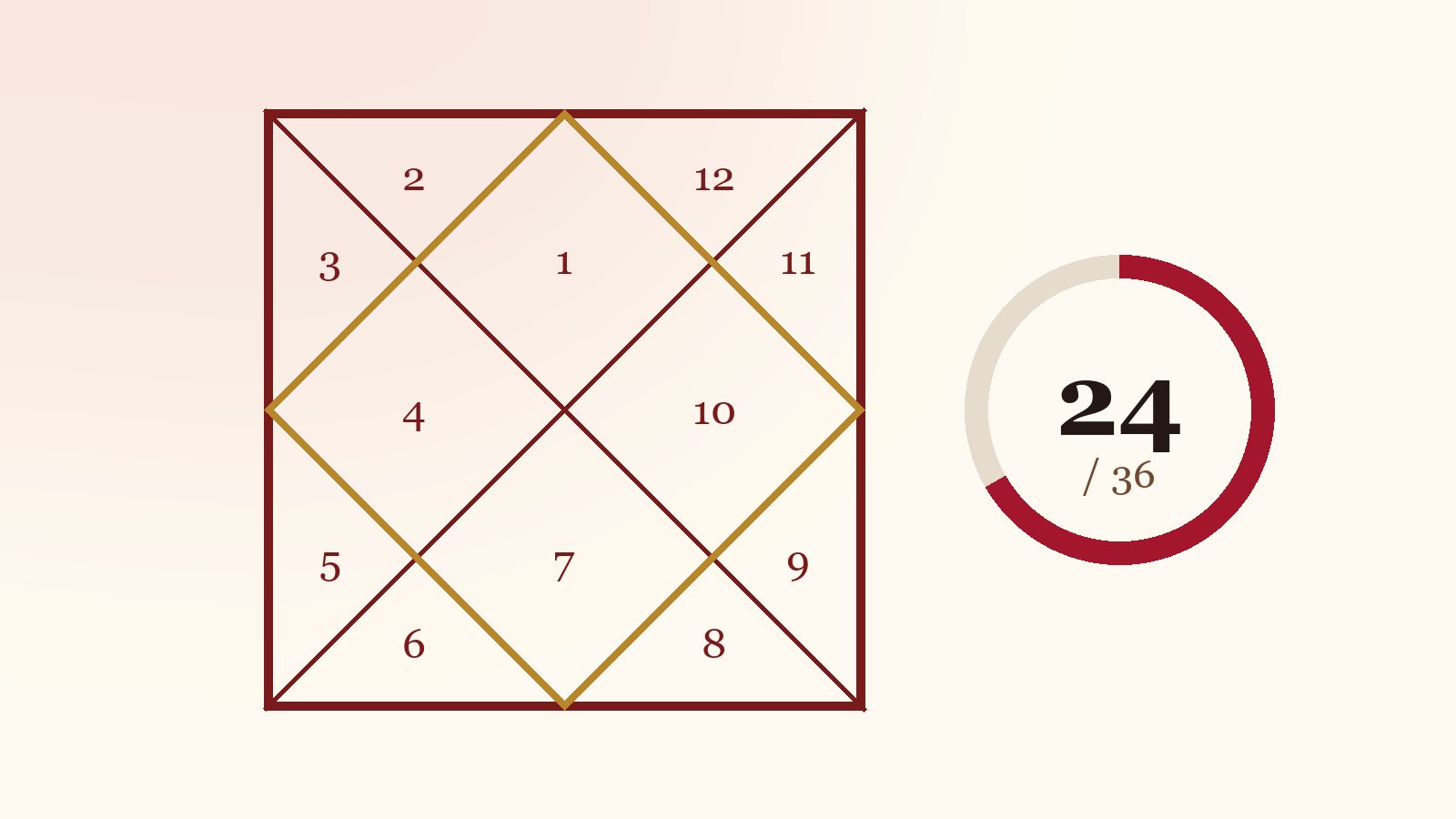
"How many gunas matched?" is often the first question a family asks after a kundli match. The short answer: 18 out of 36 is the traditional minimum, 25 or more is good, and 32 or more is excellent. But the number alone can mislead. Here's how to read a score properly, with examples at each level.
The score bands
| Gunas matched | Traditional reading | What families usually do |
|---|---|---|
| 0–17 | Below the threshold | Many families stop; some consult an astrologer about the full chart |
| 18–24 | Acceptable | Proceed, after checking doshas |
| 25–32 | Good to very good | Proceed with confidence, after checking doshas |
| 33–36 | Excellent, but rare | Proceed |
These bands come from the Ashtakoota (Guna Milan) system used in North, West and Central India. For how the 36 points are made up, see 36 gunas explained.
Why the total isn't the whole answer
Two matches with exactly the same total can be very different. Three things matter as much as the number.
1. Where the points came from
The eight kootas carry very different weights: Nadi is worth 8, Bhakoot 7 and Gana 6, while Varna is worth just 1. A score of 24 that includes a zero in Nadi is read very differently from a 24 with full Nadi points.
2. Doshas
Nadi dosha (0 out of 8 in Nadi) and Bhakoot dosha (0 out of 7 in Bhakoot) are checked separately by many families, whatever the total. Each has traditional cancellations. See Nadi dosha and Bhakoot dosha.
3. Manglik status
Manglik dosha isn't part of the 36 gunas at all; it comes from the full chart. A 30-guna match can still raise a manglik question. See Manglik dosha explained.
Examples
Example 1: 28 gunas, no doshas, neither manglik. A good match on every traditional measure. Families usually move on to meeting and to the practical questions.
Example 2: 27 gunas, but Nadi is 0. The total is good, but there is nadi dosha. Many families now check whether a traditional exception applies, for instance the same moon sign with different nakshatras. If it does, they often proceed.
Example 3: 19 gunas, no doshas. Just above the threshold, with no doshas. Many families are comfortable proceeding, especially if everything else (values, education, family) feels right.
Example 4: 16 gunas, both manglik. Below 18, though the manglik question is balanced because both are manglik. Families differ here: some stop, some ask an astrologer about the full charts.
Example 5: 33 gunas, but one partner is manglik and the other isn't. An excellent score with a manglik question. Many astrologers check for a cancellation in the charts before advising.
What a low score does and doesn't mean
A low score is a traditional signal, not a prediction. Many families who match kundlis treat it as a reason to look more carefully, not as a verdict. And many families don't match kundlis at all. Most Muslim, Christian, Sikh and Buddhist families, and many Hindu families, simply don't. See biodata without horoscope.
Porutham: a different count
South Indian families using Porutham don't count to 36. They check ten poruthams as matching or not, and usually look for at least six or seven, with Rajju and Vedha both matching. See Porutham explained.
Getting an accurate score
- Use the exact date, time and place of birth for both people
- Check that the nakshatra and charan on both biodatas are correct
- Look at every koota, not just the total
- Check Nadi, Bhakoot and Manglik separately, with cancellations
The Gun Mile Report does all four: it shows every koota's score, checks the three doshas with their common cancellations, and adds a practical-fit section from the two biodatas, in plain words, in your language.
See how two families match
Kundli matching and practical life fit, explained in plain words.
Get your Gun Mile ReportQuestions families ask
How many gunas are required for marriage?
Traditionally, at least 18 out of 36. Scores of 25 and above are considered good, and 32 and above excellent.
Is 20 gunas good for marriage?
20 is above the traditional minimum of 18 and is considered acceptable, especially if there is no uncancelled Nadi or Bhakoot dosha.
Is 30 gunas a good match?
Yes, 30 is a very good score. It is still worth checking Nadi, Bhakoot and Manglik status, because a high total can hide a dosha.
What if only 15 gunas match?
15 is below the traditional threshold. Some families stop there; others ask an astrologer to look at the full charts, where other factors are sometimes considered to offset a low score.
Do 36 out of 36 gunas ever match?
It is extremely rare. Scores above 32 are uncommon and considered excellent.
#kundli#guna-milan#score#matching
Read next
36 Gunas Explained: What Your Score Means
Guna Milan explained simply: the 8 kootas and their points, what 18, 24 or 30 out of 36 means, which doshas matter, and what the total doesn't tell you.
Kundli Matching Without Birth Time
Can you match kundlis without the birth time? What still works, what doesn't, how to find a lost birth time, and why you should never guess the time.

Bhakoot Dosha Explained: 2/12, 5/9 and 6/8
What bhakoot dosha is, why moon signs 2/12, 5/9 or 6/8 apart score 0 of 7 in Guna Milan, the traditional cancellations, and how to read it calmly.